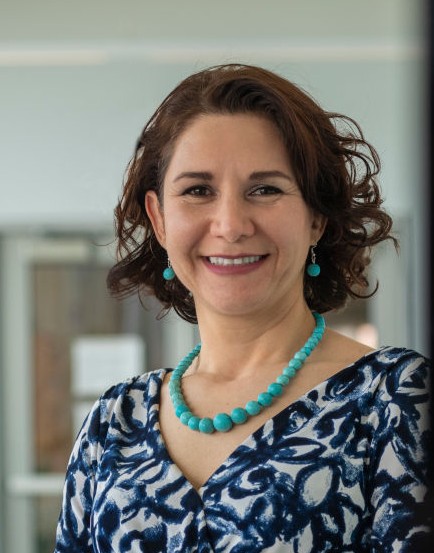
Dr. Blanca H. Lapizco-Encinas, Director
ResearcherIDGoogle Scholar
 https://orcid.org/0000-0001-6283-8210
EDUCATION
- Post-Doc in Microfluidics: Sandia National Laboratories (2003–2004). Research topic: Dielectrophoresis for the manipulation of microorganisms in water.
- Ph.D. in Chemical Engineering: University of Cincinnati, Cincinnati OH, USA (1998–2003). Fulbright Scholar. Research topic: Micro-chromatography for biomolecule purification.
- M.Sc. in Chemical Engineering: Instituto Tecnológico de Celaya, Celaya Guanajuato, Mexico (1996–1998).
- B.Sc. in Chemical Engineering: Instituto Tecnológico de Sonora, Cd. Obregón Sonora, Mexico (1991–1996).
PROFESSIONAL EXPERIENCE
- Professor and Founding Faculty, Biomedical Engineering Department, Rochester Institute of Technology, Rochester NY, USA (2019–present).
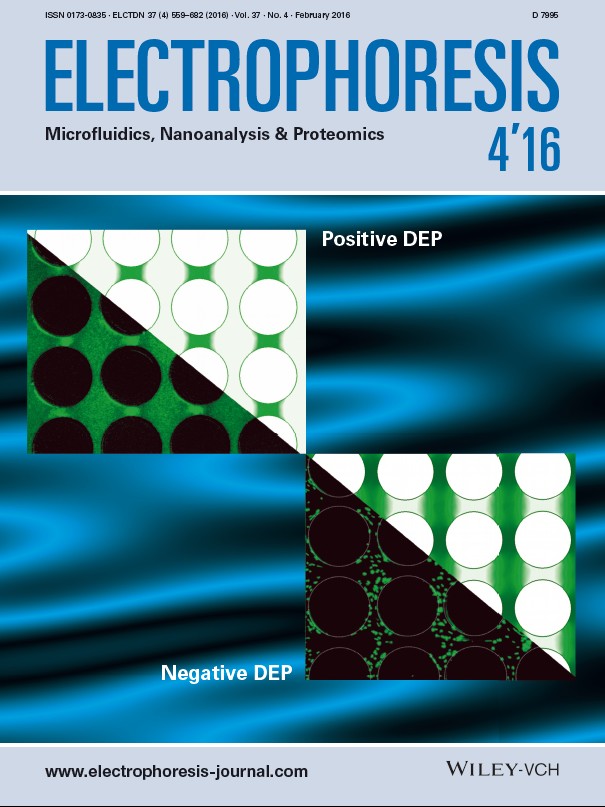
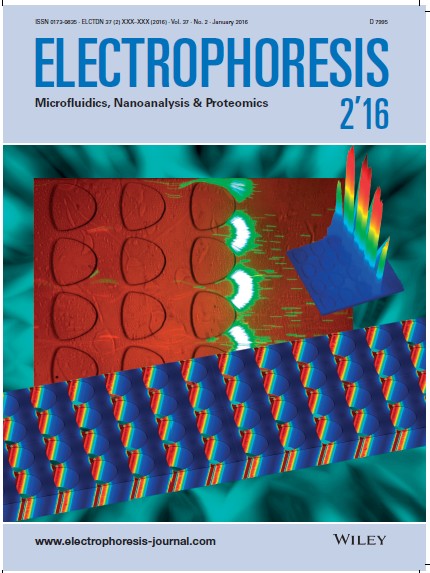
- Editor-in-Chief, ELECTROPHORESIS, journal published by Wiley (2019–2025). Deputy Editor (2011–2025).
- Associate Professor, Biomedical Engineering Department, Rochester Institute of Technology, Rochester NY, USA (2012–2019).
- Associate Professor, Chemical Engineering Department, Tennessee Technological University, Cookeville TN, USA (2011–2012).
- Senior Research Scientist & Director, Microscale Bioseparations Laboratory, CINVESTAV Unidad Monterrey, Apodaca NL, Mexico (2010–2011).
- Associate Professor, Department of Biotechnology and Food Engineering and Department of Chemical Engineering, Tecnológico de Monterrey, Monterrey NL, Mexico (2009).
- Assistant Professor, Department of Biotechnology and Food Engineering and Department of Chemical Engineering, Tecnológico de Monterrey, Monterrey NL, Mexico (2005–2009).
- Postdoctoral Researcher, Microfluidics Department, Sandia National Laboratories, Livermore CA, USA (2003–2004).
- Process Engineer, Oil extraction plant at cookie factory of GAMESA (PepsiCo subsidiary), Cd. Obregón Sonora, Mexico (1995–1996).
RESEARCH INTERESTS
Dr. Lapizco-Encinas’s research interests are in the multidisciplinary area of microfluidics, focusing on cell and macromolecule manipulation with linear and nonlinear electrokinetic methods (dielectrophoresis, electrophoresis, and electroosmosis). Her current research projects deal with the application of dielectrophoresis (iDEP) and non-antiperiodic nonlinear electrophoresis (NANEP) for the manipulation, concentration, detection, and high-resolution separation of a wide array of bioparticles such as macromolecules, proteins, DNA, bacteriophages, viruses, bacteria, yeast, microalgae, and mammalian cells. Research efforts involve mathematical modeling and numerical simulations to unveil the fundamentals of microscale electrokinetic techniques, combined with microdevice experimentation to extend their practical applications in diagnostics, therapeutics, and bioseparations.
BRIEF CV
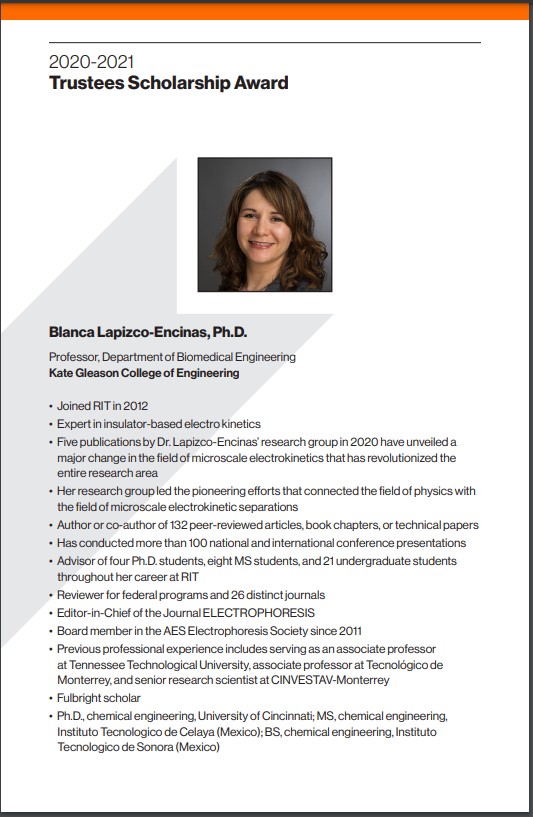
Dr. Blanca H. Lapizco-Encinas is from Cd. Obregón Sonora, a small city in Northwest Mexico. She holds B.Sc. and M.Sc. degrees in Chemical Engineering from Tecnológico de Sonora (1996) and Tecnológico de Celaya (1998), respectively. She came to the US in 1998 as a Fulbright Scholar and started her research on miniaturization and microfluidics during her PhD studies at the University of Cincinnati, where she worked toward the development of a micro-chromatograph under the supervision of Dr. Neville Pinto, graduating in January 2003. In February 2003 she joined the Microfluidics Department at Sandia National Laboratories as a post-doctoral researcher, where she worked on insulator-based dielectrophoresis (iDEP) for the concentration and separation of microbes from water. At Sandia she had the opportunity to work with Eric Cummings, one of the inventors of iDEP. Her work at Sandia led to the first viability assessment for bacteria employing iDEP, producing foundational publications that remain highly cited in the field.
From 2005 to 2011 she was a professor at Tecnológico de Monterrey and Cinvestav-Monterrey in Mexico, where she established a research group on microscale bioseparations with a focus on electrokinetics. In 2011 she came to the US and joined Tennessee Tech as an Associate Professor. In 2012, Dr. Lapizco-Encinas joined the Rochester Institute of Technology as an Associate Professor and Founding Faculty member of the Biomedical Engineering Department, where she was promoted to Full Professor in 2019. Her current research efforts are focused on the development of electrokinetic techniques for the manipulation of bioparticles.
Her work includes both experiments and mathematical modeling of electrokinetic phenomena. Her group has worked with proteins, DNA, bacteriophages, bacteria, yeast, microalgae, and mammalian and stem cells. Her main research objective is to develop electrokinetic-based microdevices that answer the needs of many different applications, such as concentrating DNA for genomics, protein purification and separation for biopharmaceuticals, microorganism manipulation and detection for food safety and environmental monitoring, and cell sorting for clinical diagnostics.
The research findings obtained by her group have been published in top international journals such as Analytical Chemistry, Lab on a Chip, Electrophoresis, TrAC Trends in Analytical Chemistry, Microfluidics and Nanofluidics, Analytical and Bioanalytical Chemistry, Journal of Chromatography A, and Biosensors, among others. Her group has presented their results in over 170 presentations at international conferences such as the American Electrophoresis Society (AES) Annual Meeting, Microscale Bioseparations, SciX/FACSS, Gordon Research Conferences (GRC), and the International Symposium on Electro- and Liquid Phase-Separation Techniques (ITP). Her work has received more than 5,000 citations with an h-index of 37 on Google Scholar. Since 2019 she has served as Editor-in-Chief for the journal Electrophoresis (Wiley). She is an inducted Member of the Mexican Academy of Sciences (AMC) and recipient of the 2021 RIT Board of Trustees Scholarship Award, the 2024–2025 AES Distinguished Service Award, and the 2023 RIT Provost’s Excellence in Faculty Mentoring Award.
SELECTED HONORS, AWARDS, AND RECOGNITIONS
- 2024–2025. Recipient of the Distinguished Service Award from the AES Electrophoresis Society.
- 2023. Recipient of the Provost’s Excellence in Faculty Mentoring Award, Rochester Institute of Technology.
- 2021. Recipient of the 2021 Board of Trustees Scholarship Award, Rochester Institute of Technology.
- 2019–2020. Recipient of the IAspire Leadership Academy Fellowship, a Leadership program sponsored by NSF.
- 2019–2025. Appointed Editor-in-Chief of ELECTROPHORESIS, journal published by Wiley.
- 2018. Received a Teaching Award for "Exemplary Performance in Teaching" during the College of Engineering Award Ceremony, Rochester Institute of Technology.
- 2018. Received two Research Awards: "Peer-Reviewed Journal Papers" and "Student Engagement", College of Engineering, Rochester Institute of Technology.
- 2018. Nominated for the RIT Provost's Excellence in Faculty Mentoring Award.
- 2017. Received a Teaching Award for "Exemplary Performance in Teaching", College of Engineering, Rochester Institute of Technology.
- 2017. Received two Research Awards: "Exemplary Performance in Externally Disseminated Works" and "Student Engagement", College of Engineering, Rochester Institute of Technology.
- 2016. Chairman for the 2016 ITP Meeting in Electro- and Liquid-Phase Separations Techniques, held September 18–23, 2016, Minneapolis, MN.
- 2016. Nominated for RIT’s 2016–2017 Outstanding Teaching Award.
- 2016. Received Teaching Award for "Exemplary Teaching Evaluations", College of Engineering, Rochester Institute of Technology.
- 2016. Received three Research Awards for "Exemplary Performance in Peer-Reviewed Journal Papers", "Research Expenditures", and "Exemplary Performance in Externally Disseminated Works", College of Engineering, Rochester Institute of Technology.
- 2015. Nominated for RIT’s 2015–2016 Trustees Scholarship Award.
- 2015. Received Research Award for "Exemplary Performance in Externally Disseminated Works", College of Engineering, Rochester Institute of Technology.
- 2014. Featured in the RIT Athenaeum for work with undergraduate researchers.
- 2014. Selected as the Scholarship Featured Faculty representing the Kate Gleason College of Engineering, Rochester Institute of Technology.
- 2014. Received two Awards for "Exemplary Performance in Peer-Reviewed Journal Papers" and "Exemplary Performance in Externally Disseminated Works", College of Engineering, Rochester Institute of Technology.
- 2013. Keynote Speaker at the III International Seminar on Chemical Engineering, Tecnológico de Monterrey, Monterrey, Mexico.
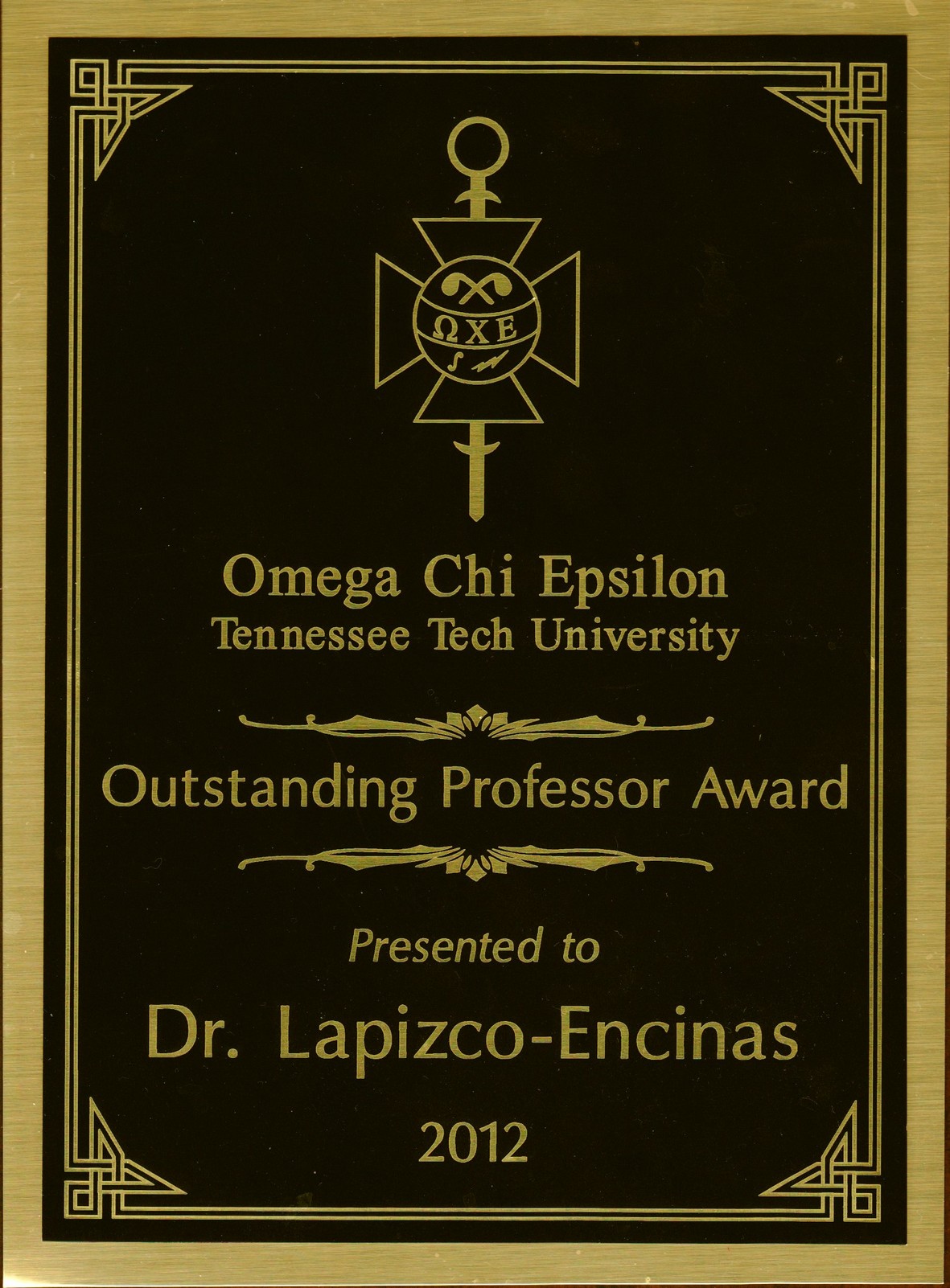
- 2012. Outstanding Professor Award 2012 given by Omega Chi Epsilon chapter at Tennessee Technological University.
- 2012. Invited Keynote Speaker at the ITP 2012—19th International Symposium on Electro- and Liquid Phase-separation Techniques, Baltimore Inner Harbor, MD, USA.
- 2011. Elected Vice President of the American Electrophoresis Society (AES).
- 2011. Appointed Deputy Editor of the international journal ELECTROPHORESIS (Wiley).
- 2011. Invited Plenary Speaker at the ASME 2011 International Mechanical Engineering Congress & Exposition, Denver, CO.
- 2011. Chairman of the 2011 Annual Meeting of the American Electrophoresis Society (AES-AIChE Topical 3), Minneapolis, MN.
- 2011. Awarded Level II by the Mexican Scientist/Researchers System (SNI).
- 2009. Inducted as Member of the Mexican Academy of Sciences.
- 2009. Fellowship from the Nature Publishing Group to attend the conference GRC Microfluidics, Physics & Chemistry Of, Lucca Barga, Italy.
- 2009. Member of Editorial Board of the journal ELECTROPHORESIS (01/2009–present).
- 2008. L’ÓREAL-UNESCO-AMC Award “For Women in Science” for research excellence, recipient of one of four awards nationwide to young female scientists in Mexico.
- 2008. Teaching and Research Award 2008, College of Biotechnology and Food, Tecnológico de Monterrey.
- 2008. First place at the poster session of the American Electrophoresis Society (jointly with AIChE Annual Meeting), Philadelphia, PA, USA.
- 2008. Awarded Level I by the Mexican Scientist/Researchers System (SNI).
- 2005. CONACyT (Mexican Council for Research) Repatriation Award.
- 2005. Awarded Level Candidate by the Mexican Scientist/Researchers System (SNI).
- 2001. University of Cincinnati Summer Research Fellowship.
- 2000. University of Cincinnati Summer Research Fellowship.
- 1998. Fulbright-CONACYT Scholarship to pursue PhD Studies.
- 1996. CONACYT Scholarship to pursue MSc Studies.
RECENT RESEARCH AWARDS OBTAINED BY RIT STUDENTS UNDER MY GUIDANCE
- 2026. Gabriela Martinez Martinez (5th year BME student) was awarded the Undergraduate Research Scholar Graduation Recognition in May 2026.
- 2025. Alaleh Vaghef-Koodehi (PhD in Biomedical and Chemical Engineering) was awarded the Graduate Research Award in biomedical and chemical engineering program at RIT in April 2025.
- 2025. Carlos Mendiola (PhD in Biomedical and Chemical Engineering) was awarded the Dr. Russell and Melissa Bessette Award for Doctoral Student Excellence 2024–2025, in April 2025.
- 2024. Alaleh Vaghef-Koodehi (PhD in Biomedical and Chemical Engineering) was awarded the Blue Fingers Award by the AES Electrophoresis Society in October 2024.
- 2023. Alaleh Vaghef-Koodehi (PhD in Biomedical and Chemical Engineering) was awarded the Graduate Research Award in biomedical and chemical engineering program at RIT in April 2023.
- 2023. Nuzhet Nihaar (PhD Microsystems Engineering) was awarded the top oral recognition at the RIT Graduate Education Week and Showcase in April 2023.
- 2022. Alaleh Vaghef-Koodehi (PhD in Biomedical and Chemical Engineering) was awarded Best Paper Award by the Journal Electrophoresis in January 2022.
- 2020. Nicole Hill (PhD Microsystems Engineering) was awarded the AES Electrophoresis Society Blue Fingers Award at the 2020 Virtual SciX Conference.
- 2019. Nicole Hill (PhD Microsystems Engineering) was awarded the Wiley Innovation Award and First Place for the FACSS Student Poster Award at the 2019 SciX Conference.
- 2019. Adriana Coll de Peña (5th year BME student) was awarded a WISE Travel Grant to attend the 2019 SciX Conference.
- 2018. Nicole Hill (PhD Microsystems) and Adriana Coll de Peña (4th year BME) were each awarded Student Travel Grants by the AES Electrophoresis Society to attend the 2018 AES Annual Meeting at SciX.
- 2017. Eric Goodrich (4th year BME student) was awarded a Travel Grant during the AES 2017 Annual Meeting (one of only two undergraduate recipients).
- 2016. Maria F. Romero-Creel (5th year BME student) was awarded First Place, poster competition at the 2016 SciX Conference, granted by FACSS.
- 2016. Mario A. Saucedo-Espinosa (4th year Microsystems PhD student) received the Tomas Hirschfeld Scholar Award, granted by FACSS, and First Place in the AES/BioMicrofluidics Art in Science competition.
- 2015. Alexandra LaLonde (5th year BME student) was awarded First Place at the undergraduate separations poster competition at the 2015 AIChE Annual Meeting.
- 2015. Maria F. Romero-Creel (4th year BME student) was awarded Second Place at the undergraduate separations poster competition at the 2015 AIChE Annual Meeting.
- 2015. Mario A. Saucedo-Espinosa (3rd year Microsystems PhD student) was awarded First Place at the 2015 AES Electrophoresis Society graduate student poster competition (AIChE Annual Meeting).
- 2014. Alexandra LaLonde (4th year BME student) was featured in the RIT Athenaeum for achievements in publishing peer-reviewed journal articles as a first author.
- 2014. Mallory Rauch (4th year BME student) was awarded Honorable Mention at the 2014 AES Electrophoresis Society graduate student poster competition (AIChE Annual Meeting).
SYNERGISTIC ACTIVITIES
-
Professional Organizations & Leadership:
- Award Chair, American Electrophoresis Society (2024–2025).
- Councilor, American Electrophoresis Society (2017–2020).
- Webmaster, American Electrophoresis Society (2012–2013).
- Vice-President, American Electrophoresis Society (2011–2012).
- Councilor, American Electrophoresis Society (2009–2011).
- Member, Mexican Academy of Sciences (2009–present).
- Editor-in-Chief of the journal ELECTROPHORESIS, published by Wiley (2019–2025).
- Deputy Editor of the journal ELECTROPHORESIS (2011–2025).
- Member of the Editorial Board of the journal ELECTROPHORESIS (01/2009–present).
- Member of Editorial Board of the journal Global Journal of Analytical Chemistry (04/2010–present).
- Guest Editor for the journal ELECTROPHORESIS for 18 special and focus issues (2011–2023), including Dielectrophoresis issues (2011, 2013, 2015, 2017, 2019, 2021, 2023), AES Annual Meeting issues (2011, 2013, 2014, 2016, 2019), Reviews 2020, Young and Inspiring Scientists (2021), and ITP 2016.
- Permanent Organizing Committee Member of the conference ITP: in Electro- and Liquid-Phase Separations Techniques (2013–present).
- Conference Chair for the 2018 Annual Meeting of the AES Electrophoresis Society at SciX, Atlanta, GA, October 2018.
- Conference Chair for the 2016 ITP Meeting in Electro- and Liquid-Phase Separations Techniques, Minneapolis, MN, September 18–23, 2016.
- Conference Chair, 2011 AES Annual Meeting in conjunction with AIChE Annual Meeting, Minneapolis, MN, October 2011.
- Session chair for numerous international conferences including AES Annual Meetings (2009–2017), SciX/FACSS (2010, 2011, 2015), and Dielectrophoresis meetings (2014, 2016).
Editorial Activities:
Conference Organizations:
RECENT INVITED TALKS AND SEMINARS
- Lapizco-Encinas B.H*., Invited Talk: Linear & Nonlinear Electrokinetic Separations, Digitizing Biology at the Point of Contact Workshop, Boston/Cambridge, March 12–13, 2024. Workshop organized by DARPA.
- Lapizco-Encinas B.H*., Invited Talk: Understanding Nonlinear Electrophoretic Effects in Microfluidic Devices, 2023 AES Annual meeting at Scix, Reno NV, 10/2023.
- Lapizco-Encinas B.H*., Invited Talk: Nonlinear electrophoresis in microscale bioseparations, 29th International Symposium on Electro- and Liquid Phase Separation Techniques (ITP 2023), San Felice Circeo, Latina, Italy, November 13–17, 2023.
- Lapizco-Encinas B.H*., Seminar: Microscale electrokinetics for bioparticle separations. Invited Seminar, University of California Irvine, Irvine, CA, April 2023.
- Lapizco-Encinas B.H*., Seminar: Nonlinear electrokinetics for microscale bioparticle analysis. Invited Seminar, Tecnológico de Monterrey, November 2022.
- Lapizco-Encinas B.H*., Seminar: Nonlinear electrokinetics for microscale bioparticle analysis. Invited Seminar, Michigan Technological University, October 2022.
- Lapizco-Encinas B.H*., Invited Talk: Nonlinear electrokinetics effects enable high-resolution separations, APCE-CECE-ITP-IUPAC, Angkor Wat, Cambodia, November 6–10, 2022.
- Lapizco-Encinas B.H*., Invited Talk: Combining Linear and Nonlinear Electrokinetic Effects in Microfluidic Devices, 2022 AES Annual meeting at Scix, Covington KY, 10/2022.
- Lapizco-Encinas B.H*., Invited Talk: Harnessing Nonlinear Electrophoresis Effects, 2022 AES Annual meeting at Scix, Covington KY, 10/2022.
- Lapizco-Encinas B.H*., Seminar: Microscale bioparticle analysis with nonlinear electrokinetic. Invited Seminar, Tecnológico de Monterrey, May 2022.
- Lapizco-Encinas B.H*., Seminar: Microscale bioparticle analysis with nonlinear electrokinetic. Invited Seminar, Oregon Health & Science University, October 2021.
- Lapizco-Encinas B.H*., Invited Talk: Rapid bioparticle analysis with electrokinetic microdevices. The Rochester Section of the American Chemical Society, May 20, 2021.
- Lapizco-Encinas B.H*., Keynote Talk: Electrokinetic Virus Detection in Microfluidic Devices. PITTCON 2021 Meeting, 03/2021.
- Lapizco-Encinas B.H*., Keynote Talk: Nonlinear Electrokinetic Effects in Devices with Insulating Structures. SciX 2020 Virtual Meeting, 10/2020.
- Lapizco-Encinas B.H*., Seminar: Nonlinear Electrokinetics in Devices with Insulating Structures. Invited Seminar, San Diego State University, November 2020.
- Lapizco-Encinas B.H*., Keynote Talk: Electric Field Driven Particle Separations with Arrays of Insulating Structures. PITTCON Conference & Expo, Chicago IL, March 1–5, 2020.
- Lapizco-Encinas B.H*., PLENARY Talk: Separation of microparticles employing electric fields in microfluidic devices. 40th Meeting of the Mexican Academy for the Research and Teaching of Chemical Engineering (AMIDIQ), Huatulco Mexico, May 7–10, 2019.
- Lapizco-Encinas B.H*., Keynote Talk: Particle separation and assessment with electric fields. 26th International Symposium on Electro- and Liquid Phase-Separation Techniques, Toulouse, France, September 1–4, 2019.
- Lapizco-Encinas B.H*., Keynote address at the Graduate Lunch: Rapid microparticle assessments with insulator based dielectrophoresis. Society of Hispanic Professional Engineers (SHPE) 2018 Convention, Cleveland Ohio, 11/08/2018.
- Lapizco-Encinas B.H*., Keynote Talk: Fine-tuning dielectrophoretic particle assessments, ITP 2018 – 25th International Symposium on Electro- and Liquid Phase-Separation Techniques, Kyoto, Japan, 08/23/2018.
- Lapizco-Encinas B.H*., Keynote Talk: Microparticle analysis with insulator based dielectrophoresis, Conference Dielectrophoresis 2018, Institute of Physics & University of Surrey, UK, 07/24/2018.
- Lapizco-Encinas B.H*., Keynote Talk: Effects of particle’s properties on dielectrophoretic separations, ITP 2017 – 24th International Symposium on Electro- and Liquid Phase-Separation Techniques, Sopot/Gdansk, Poland, (09/11/2017).
- Lapizco-Encinas B.H*., Seminar: Dielectrophoretic schemes for particle manipulation, Invited seminar, Artie McFerrin Department of Chemical Engineering, Texas A&M University (04/10/2017).
- Lapizco-Encinas B.H*., Novel strategies for particle manipulation with dielectrophoresis, RAMP Annual Symposium, Frontiers in Materials Science for the 21st Century, MEMS and Membranes, University of Rochester, Rochester, NY, 05/2016.
- Lapizco-Encinas B.H*., Dynamic schemes for particle manipulation with electric fields, Graduate Seminar Series, Mechanical Engineering, Rochester Institute of Technology, Rochester, NY, 05/2016.
- Lapizco-Encinas B.H*., Particle separation employing dielectrophoresis, Scix 2015, Providence, RI, 09/2015.
- Gencoglu, A.; LaLonde, A.; Koppula, K.; and Lapizco-Encinas B.H*., Dynamic microparticle manipulation in dielectrophoresis-based microfluidic devices, ITP 2013 - 20th International Symposium on Electro- and Liquid Phase-Separation Techniques, Tenerife, Canary Islands Spain, (10/2013).
- Lapizco-Encinas B.H*., Dynamic particle manipulation in microfluidic devices employing dielectrophoresis, Seminar, Biomedical Engineering Department, University of Rochester, February 26, 2013.
- Lapizco-Encinas B.H*., Dynamic particle manipulation in microfluidic devices employing dielectrophoresis, III International Seminar on Process Engineering, February 28–March 2, 2013, Monterrey NL, Mexico. Invited Keynote Talk.
- Lapizco-Encinas B.H*., Dielectrophoretic Manipulation of Particles: Mathematical Modeling and Experimental Results, ITP 2012: 19th International Symposium on Capillary Electroseparation Techniques, September 30 – October 3, 2012, Baltimore Inner Harbor, Maryland, USA. Invited Keynote Talk.
- Lapizco-Encinas B.H*., Microscale Electrokinetics: Dielectrophoretic Manipulation of Particles, Track 11-9, ASME 2011 International Mechanical Engineering Congress & Exposition, Denver Colorado, November 11–17, 2011. Invited Keynote Talk.
REVIEWER FOR THE FOLLOWING JOURNALS (27 DISTINCT JOURNALS)
- ELECTROPHORESIS (also Editor-in-Chief & Deputy Editor)
- Analytical and Bioanalytical Chemistry
- Analytical Chemistry
- Biomedical Microdevices
- Biomicrofluidics
- Biophysical Journal
- Biosensors
- Biotechnology and Bioengineering
- Chemical Engineering and Technology
- Colloids and Surfaces A: Physicochemical and Engineering Aspects
- Journal of Chemical Technology and Biotechnology
- Journal of Chromatography A
- Journal of the Royal Society Interface
- JoVE, Journal of Visualized Experiments
- Lab on a Chip
- Langmuir
- Methods
- Microfluidics and Nanofluidics
- Micromachines
- Nano Letters
- Physica Status Solidi
- Recent Patents on Electrical Engineering
- Revista Mexicana de Ingeniería Química
- Scientific Reports
- Sensors & Actuators: B. Chemical
- Separation and Purification Technology
- Separation Science